Image Rules
Conventional photographic wisdom, usually trotted out by some over officious camera club judge, informs us that a successful image “has” to follow a strict set of rules to ensure it’s considered worthy, you know the sort of stuff … observe the rule of 1/3rds, keep the horizon straight, keep a safe margin on both sides & top + bottom of the frame, don’t crop off people, and so on …
… well, that’s lovely if the peak of your creative flow is the archetypal sunset image over water with the silhouette of a yacht placed exactly on that right hand 1/3rd !!!
Somebody famous (but not a photographer) once said … “rules are for fools”
Fully cognisant that I’m never going to enter a camera club competition, let alone (and unlikely) win one, and neither do I particularly ever aspire to be a part of the RPS (Royal Photographic Society) I’m more than comfortable giving the ‘rules’ a swerve when it suits for the sake of creative imagery.
Consider the image below, it’s never going to be positively accepted by the constraints of Mr Camera Club judge, there’s a little too much disorder going on, yet for me it captures the evolving moment that was immediately in front of me at the instance of pressing the shutter.
The static character on the left is an anchor point of the image, immediate centre image is a character in motion and so close you feel like you could touch them, to the right we have the character that has engaged eye contact and this adds a nice bit of tension to the whole image - the other couple of characters provide a nice balance moving towards centre image from left & right respectively, and especially the character from the right who adds a further sense of dynamic and replicates the body angle of the centre image character - the image has a bit of layered depth and is captured in some favourable light.
Does it matter that the character centre image appears to have lost their head & legs below the knee ? - if I’d have stood way further back from the immediacy I was in I would have no doubt captured everything - but, and here’s the thing, images of immediacy which offer the viewer that feeling of being involved and draw them inwards will always, IMO, offer that intimate engaging visual attachment (no matter how rule breaking) than an image shot from a distance with all its detachment ever could.
The use of a wide angle lens, something like a 28mm or 35mm is ideal for creating images the draw the viewer into the frame, as a photographer you have to get close, but in doing so you have the gift to be able to create striking images that have some layered depth and context to them - a fine exponent of this type of photography is Alex Webb and his book, The Suffering of Light, is prime example of layered imagery at its finest.
Somebody famous (who was a photographer) once said … “if your images aren’t interesting enough, you’re not close enough”
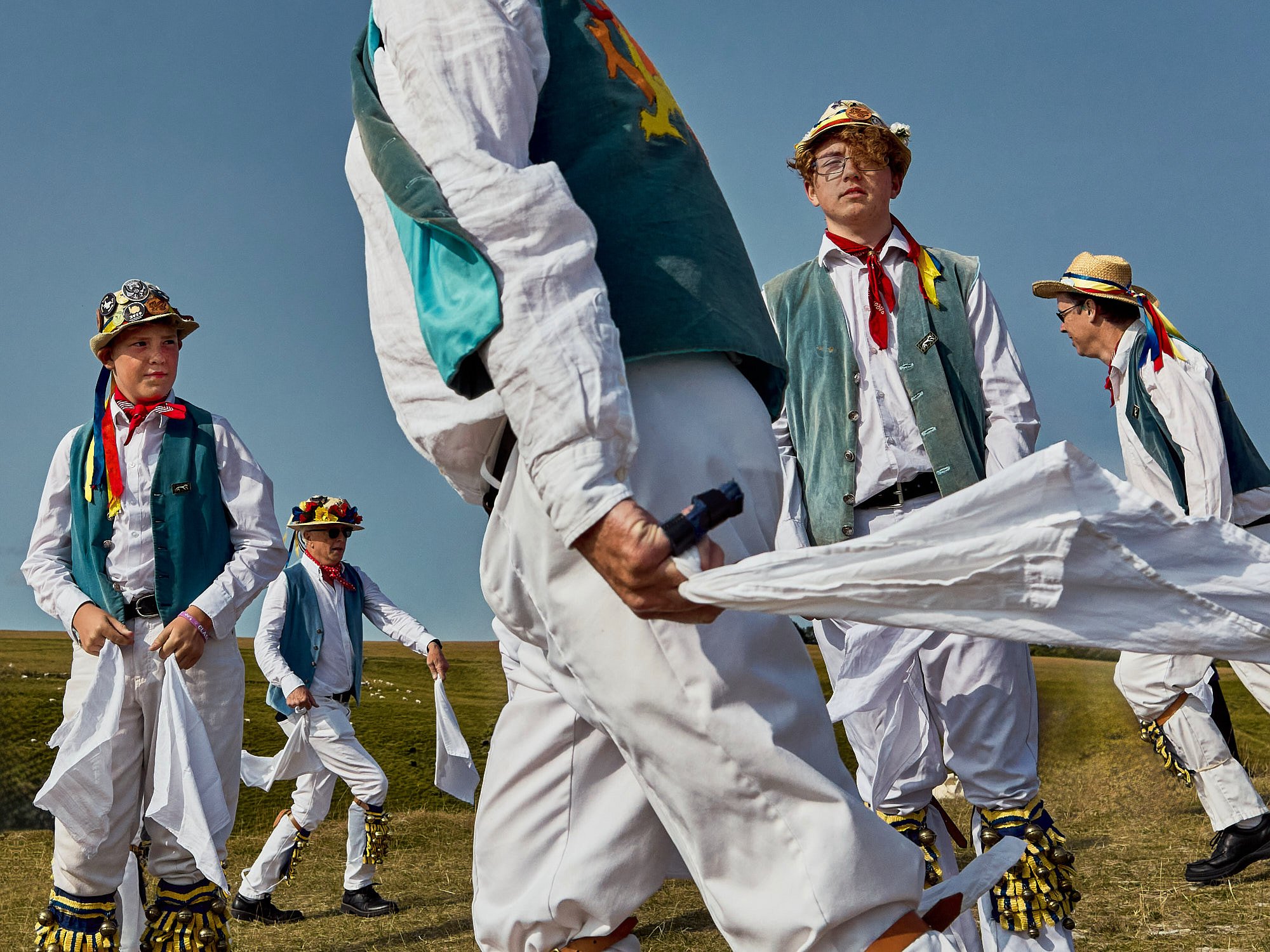
Icknield Way Morris Men - at Dragon Hill, Vale of White Horse, Oxfordshire, UK - August 2024